

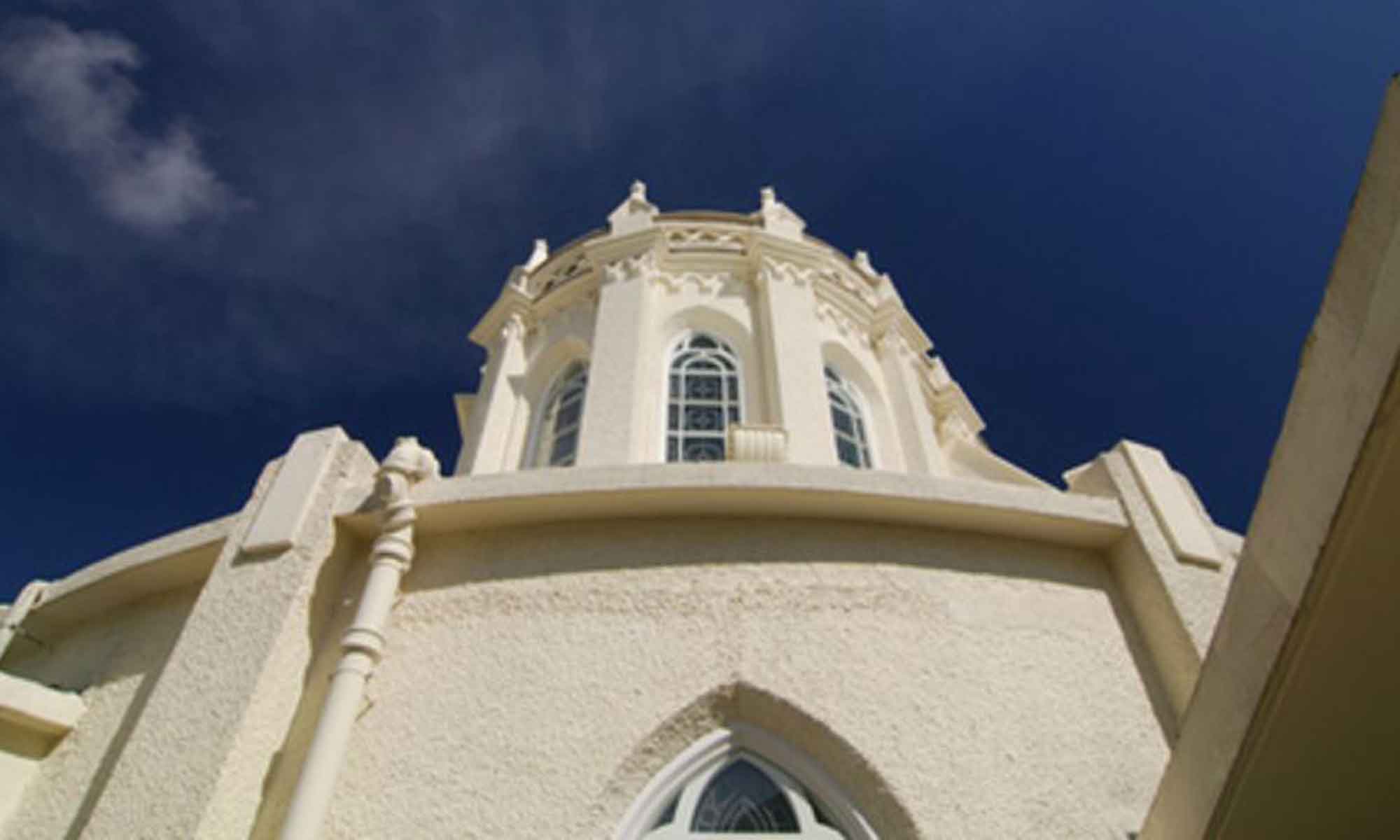

Emmanuel Church – Pok Fu Lam, Hong Kong
A daughter Church of St John's Anglican / Church of England / Episcopal Cathedral
Two truly wonderful and memorable occasions took place on the 8th and 10th September 2013 at Emmanuel Church Pokfulam and at the Hong Kong Club to celebrate Fr Nigel’s 60th Birthday.
Below are a few photos that capture the joyous spirit of both parties.


It is with great pleasure that we announce the return of the Cantata Choir to Emmanuel Church on Trinity Sunday, 26 May 2013. Choir members are alumni from the Ebenezer School for the visually impaired in Pokfulam.

This year’s visit will be the choir’s 11th time at Emmanuel, and during the Eucharist they will sing three spiritual songs, two in Chinese and one in English.
The Cantata Choir’s annual visit to Béthanie Chapel is always eagerly anticipated, and the Choir is one of this year’s designated charities being supported financially by the Emmanuel community. At the end of the service, a presentation will be made to the choir director.
EVERYONE IS WELCOME to attend this special service at Emmanuel, which starts at 10:15am on Trinity Sunday, 26 May 2013.
During the Sung Eucharist on Sunday 14 April, Fr Robert Martin CMP was warmly welcomed by Priest-in-Charge, Fr Nigel Gibson, Dean Matthias Der and many parishioners of Emmanuel Church.
In holy orders for nearly 30 years, Fr Robert comes to Emmanuel as Associate Priest and brings to the community a wide-range of ministerial experience, with singular gifts and skills in liturgy and spirituality. As well as assisting Fr Nigel on Sundays, Fr Robert will help Emmanuel develop and implement an outreach and evangelistic strategy in Pokfulam.

Congratulations to Emmanuel Church parishioners, Tim Tsang, Andrea Kan, David Wong and Cheris Yuen who were Confirmed by Archbishop Paul Kwong on Easter Eve in St John’s Cathedral. Next day on Easter Sunday all four were welcomed back to Emmanuel to great applause by their parish priest Fr Nigel and a packed congregation. Below are some photos of both ceremonies in St John’s and Emmanuel Church.


To help celebrate St Patrick’s Day, the Emmanuel Church Community enjoyed a lovely ‘Brunch-on-the-Terrace’ after the Sung Eucharist on Sunday 17 March 2013. It was a delightful gathering of parishioners and friends for fine food and fellowship. Below are some nice photos of the day. Enjoy!


The following annual report was prepared by the Rev’d Nigel Gibson, Priest-in-Charge of Emmanuel Church, Pokfulam for the St John’s Cathedral AGM, held in the Cathedral’s Li Hall on Sunday 29 April 2012.
General: Whilst it has been a year of mixed fortunes at Emmanuel, the fundamentals of the faith remain solidly in place and the heart of the community’s spiritual life continues to be the Sunday Eucharist.
The departure of both churchwardens and some other key members in the autumn was a significant setback, but the community has bounced back strongly and is now showing signs of healthy new growth. To compliment this increase I have recently appointed two new churchwardens, which has brought the Emmanuel Committee back to almost full strength. Moreover, following an excellent response to new rotas and practices, the Sunday by Sunday operation is running smoothly again.
Without a doubt the past 6 months has been a challenging period for Emmanuel, but I am confident we have now turned a corner and that the community is moving forward, albeit slowly. Over the next 12 months our focus will be on building and strengthening existing gifts and talents, of which there are a great many.
Under its new name of Emmanuel Kids, the Sunday School continues to make good use of Seasons of the Spirit worship material, an inclusive program integrating the learning, worship, and serving ministries of the Church. We have four enthusiastic and highly gifted teachers, and the children’s weekly gifts and presentations near the end of the Sunday service are always impressive. Sunday School ministry is vital to Emmanuel’s viability, and all of us in the community cannot thank the teachers enough for their on-going dedication.
Special Services: Pentecost Sunday saw the return of the wonderful Cantata Choir from the Ebenezer School for the visually impaired in Pokfulam. It was the choir’s 9th visit to Emmanuel and once again their singing was superb and inspirational. Their annual visit to Emmanuel is eagerly anticipated by both choir members and congregation alike, and their 10th visit to Emmanuel will again be on the Day of Pentecost on 27 May.
A Harvest Thanksgiving Service in October was well attended and the former Dean of St John’s gave the address. As in previous years a large amount of rice and other non-perishable food was collected for Bethune House, the Mission for Migrant Workers in HK.
Just before Christmas I officiated at a Nine Lessons and Carols Service which attracted 70 people, a 10% increase on last year. Bethanie Chapel was full to capacity for Midnight Mass and Christmas Day services, and the recent Last Hour of the Passion on Good Friday and Easter Day services were well supported.
Fundraising: Proceeds from two fund raising initiatives during the year, a Family Ceilidh, and a Quiz Night raised an impressive $62,500 for the Bethune House Migrant Women’s Refuge. During Advent a large number of soft toys and games were collected for distribution over Christmas for the Duchess of Kent Children’s Hospital at Sandy Bay.
Stewardship: One of the highlights of the year was undoubtedly the launch and implementation of a major stewardship campaign for Emmanuel. A special dinner for every parishioner at L’hotel Island South, Aberdeen was held on 23 September. The Dean of St John’s gave the keynote address on behalf of the Archbishop, and I gave a talk on the fundamentals of Christian Stewardship. As well as enjoying some lovely fellowship, the main purpose of the evening was to raise awareness that Christian stewardship involves much more than merely raising funds for ministry – it’s a way of life! Fifty people supported the event and by Christmas it became clear that the campaign generated a 30% increase in stewardship funds.
Fr Nigel S D Gibson

Our thanks to Karen Carmichael who organised the Emmanuel Quiz Night with Curry Buffet Supper held at West Island School on Friday 2nd March 2012.
We would also like to thank:
And a big thank you to all those that attended and for making the quiz night go so well. A team from the British Consulate won the Supreme Champions Mugs.
The Quiz night this year raised HKD39,000 for our chosen charity: The Bethune House Migrant Women’s Refuge.
For those who like statistics, we got through 3 barrels of beer and 57 bottles of wine!
Our chosen charity The Bethune House Migrant Women’s Refuge aims to:
Eighteen months ago Catherine Graham preached at Emmanuel.
Yesterday on the eve of the Feast of Christ the King, Saturday 19 November Catherine and five others were ordained into the Sacred Order of Priesthood at St. John’s Cathedral.
Catherine was ordained by The Most Revd. Dr. Paul Kwong, Primate and Archbishop of Hong Kong Sheng Kung Hui, Bishop of Hong Kong Island on behalf of The Rt. Revd. Nicholas Holtam, Bishop of Salisbury.
Catherine focus at St. John’s Cathedral will be as the Anglican Communion Refugee & Migrant Network Coordinator.
Below are some photos taken during the ordination service in St. John’s Cathedral
You can click on the thumbnail image to see a larger image with captions.


On Sunday 13 November 2011, Remembrance Sunday, Emmanuel Church Pokfulam welcomed back The Revd. Canon David Pickering & his wife Ms. Christine Portman. The following is David’s Remembrance Day sermon:
John 15. 13 & 14
No one has greater love than this, to lay down one’s life for one’s friends. 14You are my friends if you do what I command you.
I suppose it’s traditional and expected that on Remembrance Sunday we should focus on the words from my text, to lay down one’s life for one’s friends. After all, we are remembering those who have given their lives for others, even though they may not have actually been close or even known friends.
But this morning I’d like to reflect on just word that occurs twice in the quotation, friends.
No, I know nothing about the television programme ‘Friends’.
As many of you will know, Christine and I have three children between us; and one of the boys was particularly sociable from quite young age. Some years ago, whenever we went anywhere, he would regularly run off to play with any other children who may be around. After a while, he would return and say, “This is my friend.” And we would have to say, but what is his or her name. We had to remind him that his friend had a name and was not just an anonymous friend.
Names are very important.
One of my colleagues in the Cathedral team always greets people by name. He doesn’t just say, “Hello”, “Good morning” or whatever the appropriate greeting might be; he always adds the person’s name.
I don’t know whether anyone remembers the 1993 novel Birdsong by Sebastian Faulks. It is set around the trenches of the Somme during the First World War. But also has a later 1970s period where, Elizabeth, the grand-daughter of the central character of the trenches is trying to trace what happened all those years ago. As she visits various war memorials, she is taken aback by the long list of names. Who are all these people, some times a long list from the same family? She feels that as the years pass by the names become almost like a number, or are just a statistic, a name on a list. To quote the book, ‘the names are forgotten, and with the names their stories, their faith, their fear, replaced by cold heartless numbers.’ The sheer anonymity of their sacrifice becomes almost a scandal.
The march of history is like a march to anonymity. Names become numbers. We all have our own numbers of one kind or another; every plastic card has our number, and sometimes our name.
All over England, and no doubt in other countries, many cities, town, villages and communities have their war memorials. Some times more than one in the same locality and the list of names do not always agree.

In our village in France, there are two war memorials. One is written in Provencal, which we think refers back to the Napoleonic Wars. The other refers mainly to the First World War, with over thirty names or more, plus just three or four from the Second World War. What Christine I have tried to do is identify them with names of people we know who still live in the village.
Earlier this year, a special commemoration was made for the final surviving combatant from the First World War. No doubt in some time in the not too distant future, there will be a special commemoration for the final survivor of the Second World War. I’ve got my money on an uncle of mine who was a Battle of Britain pilot.
With time, names do become almost the same as numbers.
But Remembrance Sunday is a day to remind us of the individuality of each and every single victim of war, any war and on any side. Each one was a child of his or her parents, a husband, a wife, a partner, a brother, sister or just a very personal friend, but certainly a loved individual in the sight of God.
Yesterday, I baptised two children at the cathedral, which perhaps above all else expresses our intimate individuality in the heart and mind of God.
God has a single love for each and every human being of all times and all places.
It is important that today we remember all men and women, who have died, and are still dying, through the violence of war, as each one is remembered by and known to God.
Revd. Canon David Pickering
The Emmanuel Church – Pokfulam 2011 Family Ceilidh was held at West Island School on Saturday 5 November 2011 from 6pm to 9.30pm. It was an evening of Scottish Dancing and fun for all the family. Our thanks to Karen Carmichael for organising it, to Iain Carmichael for leading the band and to all those that helped behind the scenes to make it a success.
Below are a selection of photos and a couple of movies of turns from the 2011 Family Ceilidh at West Island School on Saturday 5 November 2011.
A selection of photos from the 2011 Family Ceilidh
You can click on the thumbnail image to see a larger image with captions.


[hr]
A Ceilidh isn’t a Ceilidh without a turn or two.
Sarah introducing Rabbi Burn’s to the next generation.
Mary playing The Butterfly.